
Axanthic Crested Geckos: A Simple Genetic Guide
Part 3 of our Morph Monday Series
What Are Axanthic Crested Geckos?
If you love that striking black-and-white look in crested geckos, you’re probably obsessed with Axanthics!
Axanthic animals have a reduction of, or lack of, xanthophores; the cells responsible for red, orange, and yellow pigments. Without those warm tones, the gecko displays a beautiful high-contrast monochromatic palette that makes them pop. Think of them as the monochrome filter of the crested gecko world!
Discovery and History
Axanthic crested geckos were first discovered in the UK and made their way to the United States thanks to Brian at Altitude Exotics.
Check out this fun throwback announcement video:
Since then, axanthic animals have popped up in other collections, including Manatee Suncoast Lizards (MSL) and Lizard Wizard (Obscurial Axanthic / OAX). While there’s friendly debate about subtle differences between lines, one thing is certain: they’re all compatible and produce that gorgeous grey-to-black base with crisp white markings.
Visual Appearance
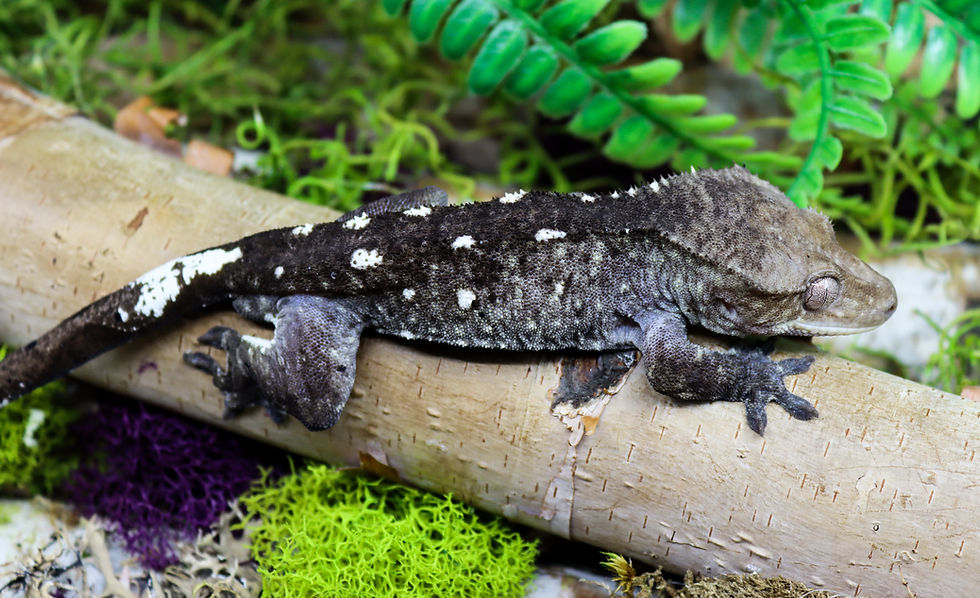
True Axanthic crested geckos typically show:
A grey to black base color
Bright white where normal geckos would show cream
Little to no red, orange, or yellow pigment (this is the key giveaway)
The result? A sleek, high-contrast reptile that looks like it stepped out of a black-and-white movie.
How Axanthic Plays With Other Traits
Axanthics are fantastic combo artists! They pair especially well with traits that boost contrast.
Best combo:
Lilly White × Axanthic - The white from Lilly White against the dark axanthic base creates jaw-dropping animals.

Challenge area:
Getting strong harlequin patterns on axanthics has proven tricky. There’s still plenty of exciting work left to do in this morph!
Genetics: Simple Recessive Trait
Axanthic is a simple recessive mutation. This means a gecko must inherit the axanthic gene from both parents to visually express it.
Allele Notation:
A = Wild-type (normal pigment)
a = Recessive axanthic allele
Genotypes:
AA — Normal (can show full yellow/red pigment)
Aa — Heterozygous (het axanthic) — Looks normal but carries the gene
aa — Visual Axanthic (homozygous recessive)
Punnett Square Examples
Here’s how the genetics shake out in different breedings:
Visual Axanthic × Visual Axanthic (aa × aa) → 100% visual axanthic (aa)
Visual Axanthic × Het Axanthic (aa × Aa) → 50% visual axanthic (aa) → 50% het axanthic (Aa)
Het Axanthic × Het Axanthic (Aa × Aa) → 25% visual axanthic (aa) → 50% het axanthic (Aa) → 25% normal (AA)
Visual Axanthic × Normal (aa × AA) → 100% het axanthic (Aa) — No visuals
Our Plans at Rockstar Geckos
We’ve been working with axanthics for several years now, focusing on better structure, stronger patterns, and incorporating them into our Phantom Harlequin line.
This season we’re thrilled to have produced our first 100% het axanthic het leucistic babies!
Final Thoughts
Axanthic crested geckos are stunning, still relatively rare, and incredibly rewarding to work with. Because they’re a simple recessive trait, they require patience and planning, but that just makes the first visual axanthic hatchling feel like pure magic.
If you love bold contrast and elegant simplicity, axanthics might just be your new favorite morph!


Comments